
Finding Matrix Inverse Using the Adjugate and Determinant Method: Formula & Step-by-Step Examples
Master calculating matrix inverses using the Adjugate (Adjoint) and Determinant formula A^-1 = (1/det(A)) * adj(A) with clear worked examples.
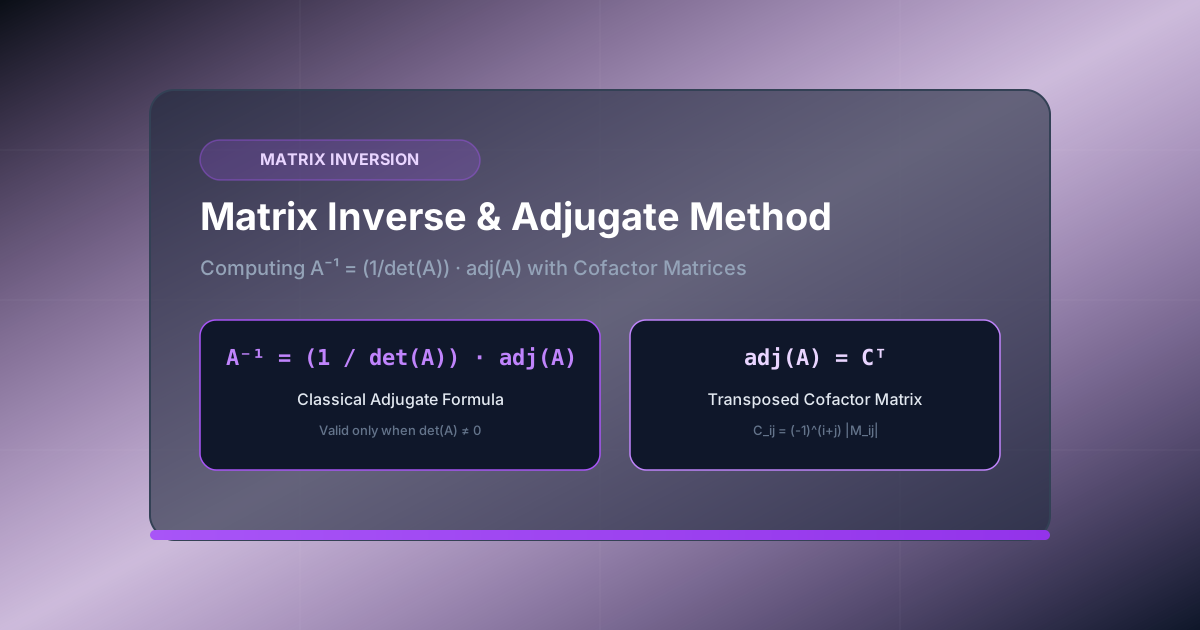
Direct Answer: The inverse of a square matrix $A$ is calculated using the adjugate formula $A^{-1} = \frac{1}{\det(A)} \text{adj}(A)$, where $\text{adj}(A)$ is the transpose of the cofactor matrix $C^T$. The inverse exists if and only if $\det(A) \neq 0$.
Finding the inverse of a matrix ($A^{-1}$) is one of the most fundamental operations in linear algebra. Among the various methods available—such as Gauss-Jordan elimination and LU Decomposition—the Adjugate (Adjoint) and Determinant Method provides a direct explicit formula for computing matrix inverses.
In this guide, we explore the formula $A^{-1} = \frac{1}{\det(A)} \text{adj}(A)$, walk through step-by-step 2x2 and 3x3 worked examples, and explain when to apply it.
The Inverse Formula
For any square matrix $A$ where $\det(A) \neq 0$ (verified by the Invertible Matrix Theorem), its inverse is given by:
$$A^{-1} = \frac{1}{\det(A)} \text{adj}(A)$$
Where:
- $\det(A)$ is the scalar determinant of $A$.
- $\text{adj}(A)$ is the adjugate matrix, which is the transpose of the cofactor matrix $C$: $$\text{adj}(A) = C^T$$
1. Finding the Inverse of a 2x2 Matrix
For a 2x2 matrix $A$:
$$A = \begin{bmatrix} a & b \ c & d \end{bmatrix}$$
- Calculate the determinant: $$\det(A) = ad - bc$$
- Form the adjugate matrix (swap main diagonal entries $a$ and $d$, flip signs of off-diagonal entries $b$ and $c$): $$\text{adj}(A) = \begin{bmatrix} d & -b \ -c & a \end{bmatrix}$$
- Multiply by $\frac{1}{\det(A)}$: $$A^{-1} = \frac{1}{ad - bc} \begin{bmatrix} d & -b \ -c & a \end{bmatrix}$$
2. Finding the Inverse of a 3x3 Matrix: Step-by-Step
Let’s find the inverse of matrix $M$:
$$M = \begin{bmatrix} 1 & 0 & 2 \ 2 & -1 & 3 \ 4 & 1 & 8 \end{bmatrix}$$
Step 1: Calculate $\det(M)$
Using minor expansion (see How to Find 3x3 Determinant Step by Step):
$$\det(M) = 1((-1)(8) - (3)(1)) - 0 + 2((2)(1) - (-1)(4))$$ $$= 1(-8 - 3) + 2(2 + 4) = -11 + 12 = 1$$
Since $\det(M) = 1 \neq 0$, the inverse exists!
Step 2: Compute the Cofactor Matrix $C$
For each element $m_{ij}$, the cofactor is $C_{ij} = (-1)^{i+j} M_{ij}$:
$$C = \begin{bmatrix} \begin{vmatrix} -1 & 3 \ 1 & 8 \end{vmatrix} & -\begin{vmatrix} 2 & 3 \ 4 & 8 \end{vmatrix} & \begin{vmatrix} 2 & -1 \ 4 & 1 \end{vmatrix} \[1em] -\begin{vmatrix} 0 & 2 \ 1 & 8 \end{vmatrix} & \begin{vmatrix} 1 & 2 \ 4 & 8 \end{vmatrix} & -\begin{vmatrix} 1 & 0 \ 4 & 1 \end{vmatrix} \[1em] \begin{vmatrix} 0 & 2 \ -1 & 3 \end{vmatrix} & -\begin{vmatrix} 1 & 2 \ 2 & 3 \end{vmatrix} & \begin{vmatrix} 1 & 0 \ 2 & -1 \end{vmatrix} \end{bmatrix}$$
Evaluating each 2x2 determinant:
$$C = \begin{bmatrix} -11 & -4 & 6 \ 2 & 0 & -1 \ 2 & 1 & -1 \end{bmatrix}$$
Step 3: Transpose $C$ to get $\text{adj}(M)$
$$\text{adj}(M) = C^T = \begin{bmatrix} -11 & 2 & 2 \ -4 & 0 & 1 \ 6 & -1 & -1 \end{bmatrix}$$
Step 4: Multiply by $\frac{1}{\det(M)}$
Since $\det(M) = 1$:
$$M^{-1} = \begin{bmatrix} -11 & 2 & 2 \ -4 & 0 & 1 \ 6 & -1 & -1 \end{bmatrix}$$
Software Utilities & Computational Systems
Performing manual cofactor transpose computations for 3x3 matrices requires attention to detail.
Using our automated determinant calculator allows students and engineers to compute matrix determinants and verify steps instantly.
In modern software development, specialized computation engines power diverse applications. Experienced teams hire a software developer for custom enterprise platforms, build patient management software for medical practices, leverage design tools for media, build website authority through link building, convert athletic timings using a swimming converter, and explore developer career opportunities.
Frequently Asked Questions (PAA)
What happens if $\det(A) = 0$?
If $\det(A) = 0$, division by zero is undefined ($\frac{1}{0}$). The matrix is singular and does not have an inverse according to the Invertible Matrix Theorem.
Is the adjugate method efficient for 5x5 matrices?
No. Computing the adjugate of a 5x5 matrix requires computing 25 separate 4x4 determinants. For 4x4 matrices and larger, Gauss-Jordan elimination or LU Decomposition is far more efficient.
What is the determinant of $A^{-1}$?
By Matrix Determinant Properties, $\det(A^{-1}) = \frac{1}{\det(A)}$.
Related Linear Algebra Guides
- Invertible Matrix Theorem & Determinants
- How to Find the Determinant of a 3x3 Matrix
- Cramer’s Rule: Solving Linear Systems
Need additional tools?
Explore our complete collection of SEO software, AI tools, business applications, calculators and converters.
Related Resources
Hand-picked web applications and engineering utilities from our network
- • InstantSEOScan – Analyze your website health and uncover ranking bottlenecks with advanced SEO audit tools. AI-powered SEO auditing tools .
- • DentalLeadCRM – Streamline patient scheduling and automate lead management for dental practices. patient management software .
- • JPEGtoSVG – Convert raster PNG and JPEG images into clean, scalable SVG vector graphics. vector converter .
- • Backlink Platform – Publish your site to curated backlink sources and improve organic domain authority. build backlinks .
- • Shahab Dev – Build tailored web applications, enterprise SaaS, CRM solutions, and AI automations. custom software development .