
Mastering Cramer's Rule: Solving Systems of Linear Equations Using Determinants
A comprehensive guide to Cramer's Rule for solving 2x2 and 3x3 linear equation systems with step-by-step formulas and matrix determinants.
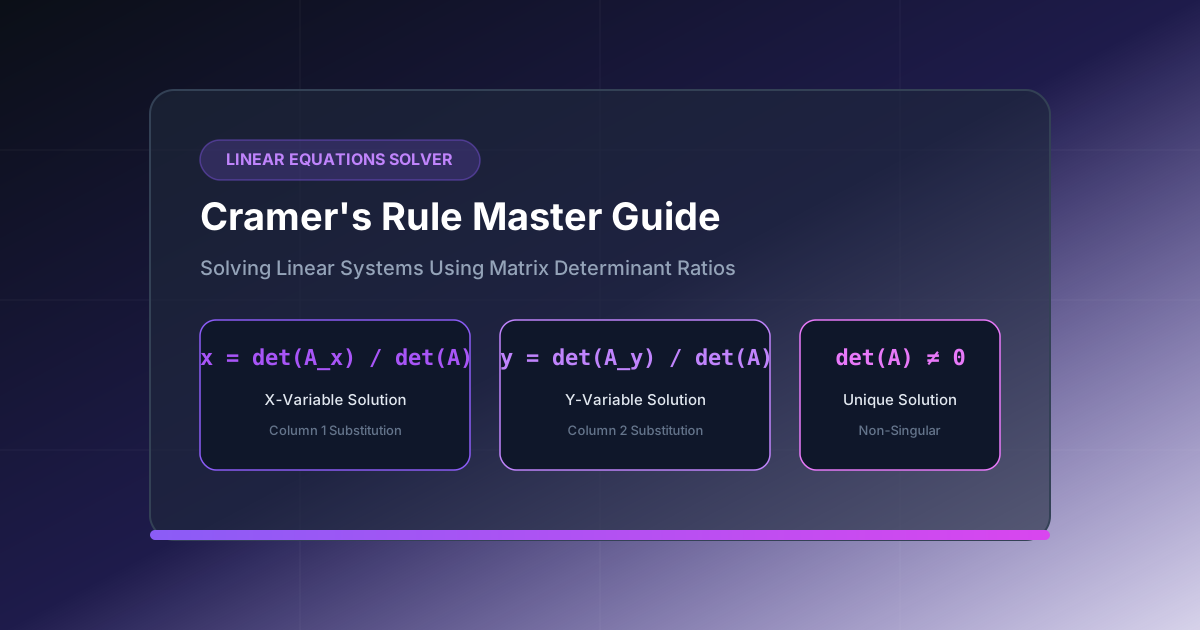
Direct Answer: Cramer’s Rule solves a system of linear equations $AX = B$ by expressing each variable as a ratio of matrix determinants: $x_i = \det(A_i) / \det(A)$, where $A_i$ is formed by replacing the $i$-th column of coefficient matrix $A$ with constant vector $B$. It applies if and only if $\det(A) \neq 0$.
Cramer’s Rule is an explicit formula for solving a system of linear equations with as many equations as unknowns, provided that the system has a unique solution. Named after Swiss mathematician Gabriel Cramer, this rule relies directly on calculating matrix determinants.
In this guide, we will break down Cramer’s Rule formula, demonstrate worked 2x2 and 3x3 examples, and analyze when to apply it in modern scientific computing.
What is Cramer’s Rule?
Consider a system of $n$ linear equations expressed in matrix form:
$$A X = B$$
Where $A$ is an $n \times n$ coefficient matrix, $X$ is the vector of variables, and $B$ is the column vector of constant terms.
If $\det(A) \neq 0$ (confirming matrix invertibility per the Invertible Matrix Theorem), Cramer’s Rule states that the value of each variable $x_i$ is given by:
$$x_i = \frac{\det(A_i)}{\det(A)}$$
Where $A_i$ is the matrix formed by replacing the $i$-th column of $A$ with the constant vector $B$.
Solving a 2x2 System of Linear Equations
Consider the system: $$2x + 3y = 8$$ $$5x - 1y = 3$$
Step 1: Form the Coefficient Matrix $A$
$$A = \begin{bmatrix} 2 & 3 \ 5 & -1 \end{bmatrix}$$
Calculate $\det(A)$: $$\det(A) = (2)(-1) - (3)(5) = -2 - 15 = -17$$
Step 2: Form $A_x$ by replacing column 1 with vector $B = \begin{bmatrix} 8 \ 3 \end{bmatrix}$
$$A_x = \begin{bmatrix} 8 & 3 \ 3 & -1 \end{bmatrix}$$
Calculate $\det(A_x)$: $$\det(A_x) = (8)(-1) - (3)(3) = -8 - 9 = -17$$
Step 3: Form $A_y$ by replacing column 2 with vector $B$
$$A_y = \begin{bmatrix} 2 & 8 \ 5 & 3 \end{bmatrix}$$
Calculate $\det(A_y)$: $$\det(A_y) = (2)(3) - (8)(5) = 6 - 40 = -34$$
Step 4: Compute Variables
$$x = \frac{\det(A_x)}{\det(A)} = \frac{-17}{-17} = 1$$ $$y = \frac{\det(A_y)}{\det(A)} = \frac{-34}{-17} = 2$$
For 3x3 linear systems, you can evaluate 3x3 determinants using Sarrus’ Rule or our step-by-step guide on How to Find the Determinant of a 3x3 Matrix.
When Should You Use Cramer’s Rule?
While Cramer’s Rule is theoretically elegant for 2x2 and 3x3 systems, its computational cost grows exponentially ($O(n!)$) if computed naively by determinants. For larger systems (4x4 and beyond), numerical methods like LU Decomposition or the Matrix Inverse Adjugate Method are far more efficient.
Using a fast digital determinant solver allows engineers to compute determinants instantly without manual calculation errors.
Calculations of all kinds power everyday tools—from converting metric weights with a weight converter to transforming geometric vectors with a coordinate converter. In business and web technology, automated systems drive growth, whether through an automated link building strategy, specialized patient management software, or finding developer roles on a global job board.
Frequently Asked Questions (PAA)
What happens if $\det(A) = 0$ in Cramer’s Rule?
If $\det(A) = 0$, Cramer’s Rule cannot be applied because division by zero is undefined. The system either has infinitely many solutions (dependent system) or no solution at all (inconsistent system).
Is Cramer’s Rule efficient for 10x10 matrices?
No. Computing a 10x10 determinant via naive expansion requires over 3.6 million multiplications. LU Factorization is preferred for high-dimensional systems.
Can Cramer’s Rule be used for non-square matrices?
No. Cramer’s Rule requires the coefficient matrix to be square ($n \times n$) so that determinants exist for both $A$ and modified matrices $A_i$.
Related Linear Algebra Guides
- How to Find the Determinant of a 3x3 Matrix
- LU Decomposition for Determinant Calculation
- Invertible Matrix Theorem & Determinants
Need additional tools?
Explore our complete collection of SEO software, AI tools, business applications, calculators and converters.
Related Resources
Hand-picked web applications and engineering utilities from our network
- • InstantSEOScan – Analyze your website health and uncover ranking bottlenecks with advanced SEO audit tools. AI-powered SEO auditing tools .
- • DentalLeadCRM – Streamline patient scheduling and automate lead management for dental practices. patient management software .
- • JPEGtoSVG – Convert raster PNG and JPEG images into clean, scalable SVG vector graphics. vector converter .
- • Backlink Platform – Publish your site to curated backlink sources and improve organic domain authority. build backlinks .
- • Shahab Dev – Build tailored web applications, enterprise SaaS, CRM solutions, and AI automations. custom software development .