
LU Decomposition for Determinants: How Algorithms Calculate 4x4, 5x5, and 6x6 Matrices
Discover how computers calculate high-order matrix determinants using LU decomposition with partial pivoting for numerical stability and speed.
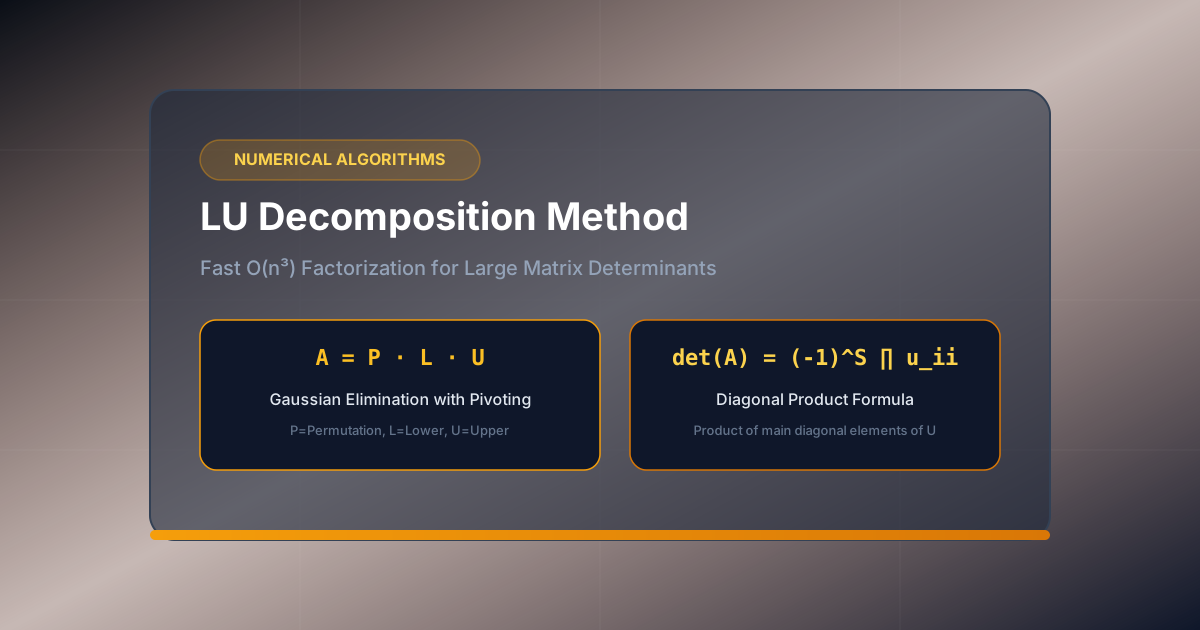
Direct Answer: LU Decomposition calculates matrix determinants by factoring coefficient matrix $A$ into lower ($L$) and upper ($U$) triangular matrices with row permutation matrix $P$: $PA = LU$. Because the determinant of a triangular matrix equals the product of its diagonal entries, $\det(A) = (-1)^s \prod u_{ii}$, where $s$ is the number of row swaps.
When calculating determinants for small matrices like 2x2 or 3x3, cofactor expansion or Sarrus’ Rule is straightforward. However, for 4x4, 5x5, 6x6, or larger matrices, naive expansion by minors requires $O(n!)$ operations—making it computationally impossible even on supercomputers.
To solve large matrices in milliseconds, numerical algorithms rely on LU Decomposition with Partial Pivoting ($P A = L U$). In this guide, we explore how LU factorization works and why computers use it.
The Computational Bottleneck of Minor Expansion
Comparing time complexity between algorithms highlights why LU decomposition is essential:
- Laplace Expansion (Minors): $O(n!)$ time complexity. A 10x10 matrix requires over 3.6 million operations! See How to Find 3x3 Determinant Step by Step for minor expansion details.
- LU Factorization: $O(n^3)$ time complexity. A 10x10 matrix requires only ~1,000 operations!
What is LU Decomposition?
LU decomposition factors a square matrix $A$ into the product of a lower triangular matrix $L$ and an upper triangular matrix $U$, controlled by a permutation matrix $P$ for row swaps:
$$P A = L U$$
- Matrix $P$ (Permutation): Tracks row interchanges performed to maintain numerical stability during partial pivoting. $\det(P) = (-1)^s$, where $s$ is the number of row swaps.
- Matrix $L$ (Lower Triangular): Has 1s on the main diagonal. Therefore, $\det(L) = 1$.
- Matrix $U$ (Upper Triangular): Has entries $u_{ii}$ on the main diagonal. Its determinant is the product of its diagonal elements: $$\det(U) = \prod_{i=1}^n u_{ii}$$
Formula for Determinant via LU
Using the multiplicative property of determinants ($\det(AB) = \det(A)\det(B)$ as explained in Matrix Determinant Properties):
$$\det(P) \cdot \det(A) = \det(L) \cdot \det(U)$$
Since $\det(P) = (-1)^s$ and $\det(L) = 1$:
$$\det(A) = (-1)^s \cdot \prod_{i=1}^n u_{ii}$$
The determinant of $A$ equals the product of the diagonal elements of $U$, multiplied by $-1$ for every row swap performed!
Numerical Stability: Why Partial Pivoting Matters
When computers perform division by near-zero values during Gaussian elimination, rounding errors can accumulate exponentially. Partial pivoting selects the row with the largest absolute value in the pivot column before eliminating sub-diagonal elements, preserving precision and verifying conditions in the Invertible Matrix Theorem.
Our online determinant solver implements LU decomposition with partial pivoting in pure JavaScript, allowing instantaneous, robust calculations up to 6x6.
Technology Infrastructure & Software Architecture
Algorithmic efficiency is the foundation of high-performance modern software. At Shahab Dev, developers build optimized SaaS architectures, implement healthcare dental automation, build scalable SEO backlinks engines, create engineering tools like an engineering converter or a precise unit converter, and connect engineers through platforms to find jobs.
Frequently Asked Questions (PAA)
Can LU decomposition fail?
LU decomposition without pivoting fails if a zero pivot is encountered. However, LU decomposition with partial pivoting ($PA=LU$) is guaranteed to succeed for any non-singular square matrix where $\det(A) \neq 0$.
Why is $\det(L) = 1$?
By convention in Doolittle algorithm LU factorization, $L$ is a unit lower triangular matrix with 1s along the main diagonal. Since it is triangular, its determinant is the product of diagonal 1s, which equals 1.
How fast is LU decomposition for high-order matrices?
LU decomposition operates in $O(n^3)$ polynomial time. This enables calculating determinants for 100x100 matrices in less than a second on modern computer processors.
Related Linear Algebra Guides
- How to Find the Determinant of a 3x3 Matrix
- Matrix Determinant Properties Explained
- Invertible Matrix Theorem & Determinants
Need additional tools?
Explore our complete collection of SEO software, AI tools, business applications, calculators and converters.
Related Resources
Hand-picked web applications and engineering utilities from our network
- • InstantSEOScan – Analyze your website health and uncover ranking bottlenecks with advanced SEO audit tools. AI-powered SEO auditing tools .
- • DentalLeadCRM – Streamline patient scheduling and automate lead management for dental practices. patient management software .
- • JPEGtoSVG – Convert raster PNG and JPEG images into clean, scalable SVG vector graphics. vector converter .
- • Backlink Platform – Publish your site to curated backlink sources and improve organic domain authority. build backlinks .
- • Shahab Dev – Build tailored web applications, enterprise SaaS, CRM solutions, and AI automations. custom software development .