
Sarrus' Rule for 3x3 Determinants: Shortcuts, Worked Examples, and Common Pitfalls
Learn Sarrus' Rule diagonal trick for fast 3x3 determinant evaluation, understand why it fails on 4x4 matrices, and explore worked examples.
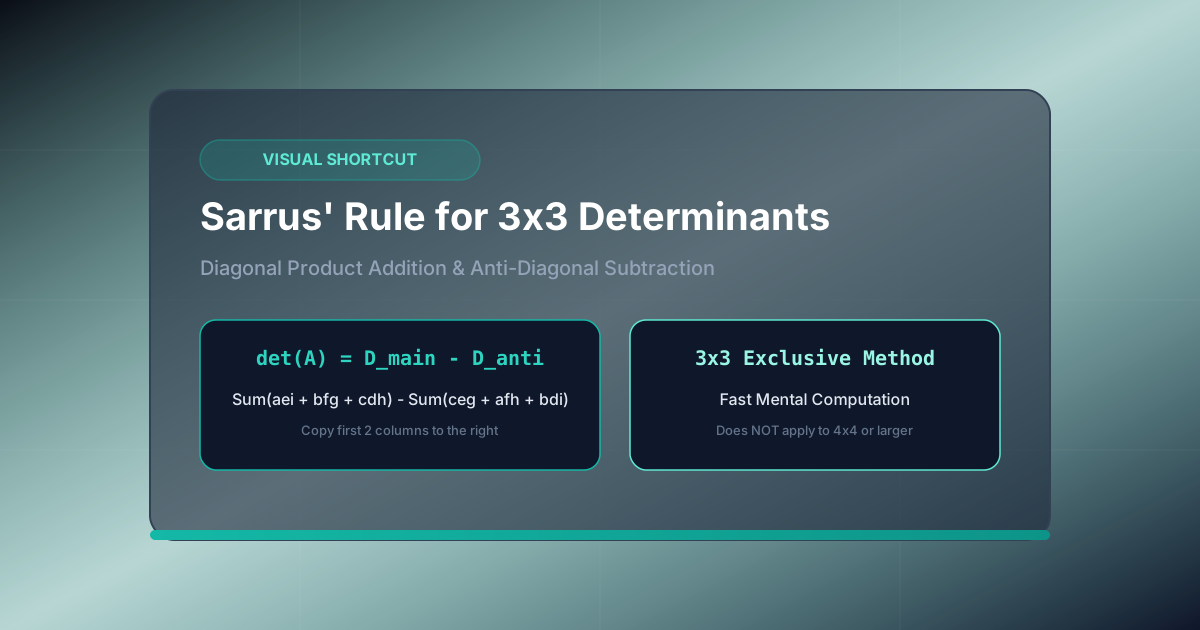
Direct Answer: Sarrus’ Rule is a diagonal multiplication shortcut exclusively for 3x3 matrix determinants: copy the first two columns to the right, sum the 3 main diagonal products $D_1 = aei + bfg + cdh$, sum the 3 anti-diagonal products $D_2 = ceg + afh + bdi$, and compute $\det(A) = D_1 - D_2$. It does NOT work on 4x4 or larger matrices.
When students first encounter 3x3 matrix determinants, calculating minors and alternating signs can feel tedious. Sarrus’ Rule (also known as the rule of diagonal multiplication) is a famous visual shortcut that speeds up manual 3x3 determinant calculations.
However, while Sarrus’ Rule is fast and reliable for 3x3 matrices, it comes with a major catch: it fails completely for 4x4 and higher-dimensional matrices.
In this article, we explain how to apply Sarrus’ Rule correctly, provide worked examples, and clarify why it cannot be generalized.
How Sarrus’ Rule Works
Consider a 3x3 matrix:
$$A = \begin{bmatrix} a & b & c \ d & e & f \ g & h & i \end{bmatrix}$$
Step 1: Augment the Matrix
Write out the matrix and append a copy of the first two columns to its right:
$$\begin{matrix} a & b & c & | & a & b \ d & e & f & | & d & e \ g & h & i & | & g & h \end{matrix}$$
Step 2: Multiply Downward Diagonals (Add)
Calculate the three top-left to bottom-right products and sum them:
$$P_{\text{down}} = (a \cdot e \cdot i) + (b \cdot f \cdot g) + (c \cdot d \cdot h)$$
Step 3: Multiply Upward Diagonals (Subtract)
Calculate the three bottom-left to top-right products and sum them:
$$P_{\text{up}} = (g \cdot e \cdot c) + (h \cdot f \cdot a) + (i \cdot d \cdot b)$$
Step 4: Subtract $P_{\text{up}}$ from $P_{\text{down}}$
$$\det(A) = P_{\text{down}} - P_{\text{up}}$$
Worked Example
Let’s evaluate the determinant of matrix $M$:
$$M = \begin{bmatrix} 1 & 2 & 3 \ 0 & 4 & 5 \ 1 & 0 & 6 \end{bmatrix}$$
-
Downward products:
- $1 \times 4 \times 6 = 24$
- $2 \times 5 \times 1 = 10$
- $3 \times 0 \times 0 = 0$
- Sum $P_{\text{down}} = 24 + 10 + 0 = 34$
-
Upward products:
- $1 \times 4 \times 3 = 12$
- $0 \times 5 \times 1 = 0$
- $6 \times 0 \times 2 = 0$
- Sum $P_{\text{up}} = 12 + 0 + 0 = 12$
-
Final Result: $$\det(M) = 34 - 12 = 22$$
Compare this result with Expansion by Minors to verify consistency.
Why Sarrus’ Rule Fails for 4x4 Matrices
A 3x3 determinant is the sum of $3! = 6$ permutations (3 positive, 3 negative). Sarrus’ Rule captures all 6 terms visually.
However, a 4x4 determinant contains $4! = 24$ permutations. If you attempt a diagonal drawing method on a 4x4 matrix, it yields only 8 terms (4 positive, 4 negative)—missing 16 critical terms! Thus, never use Sarrus’ Rule on a 4x4 matrix. For 4x4 matrices, use LU Decomposition.
Digital Calculators & Automation
For fast, accurate matrix computations without memory pitfalls, use our automated online determinant solver.
In digital engineering and online operations, relying on dedicated software tools ensures precision. Construction engineers estimate materials with a board foot calculator, design teams utilize SVG conversion utilities, digital marketers optimize site visibility with a website audit, agency teams execute link building, medical offices manage patient schedules via appointment management systems, and developers browse remote jobs on specialized career boards.
Frequently Asked Questions (PAA)
Can Sarrus’ Rule handle negative numbers?
Yes! Be careful to track signs when multiplying negative elements along diagonals.
Who invented Sarrus’ Rule?
It was introduced by French mathematician Pierre Frédéric Sarrus in 1833 as a visual mnemonic device for students evaluating 3x3 matrices.
How does Sarrus’ Rule connect to 3D parallelepiped volume?
The 6 terms in Sarrus’ Rule expand the scalar triple product $\vec{u} \cdot (\vec{v} \times \vec{w})$. Learn more in Calculating Area and Volume Using Determinants.
Related Linear Algebra Guides
- How to Find the Determinant of a 3x3 Matrix
- LU Decomposition for Determinant Calculation
- Calculating Area and Volume Using Determinants
Need additional tools?
Explore our complete collection of SEO software, AI tools, business applications, calculators and converters.
Related Resources
Hand-picked web applications and engineering utilities from our network
- • InstantSEOScan – Analyze your website health and uncover ranking bottlenecks with advanced SEO audit tools. AI-powered SEO auditing tools .
- • DentalLeadCRM – Streamline patient scheduling and automate lead management for dental practices. patient management software .
- • JPEGtoSVG – Convert raster PNG and JPEG images into clean, scalable SVG vector graphics. vector converter .
- • Backlink Platform – Publish your site to curated backlink sources and improve organic domain authority. build backlinks .
- • Shahab Dev – Build tailored web applications, enterprise SaaS, CRM solutions, and AI automations. custom software development .