
The Invertible Matrix Theorem: Why Non-Zero Determinants Rule Linear Algebra
Understand the Invertible Matrix Theorem and discover how non-zero determinants guarantee invertibility, full rank, and unique solutions.
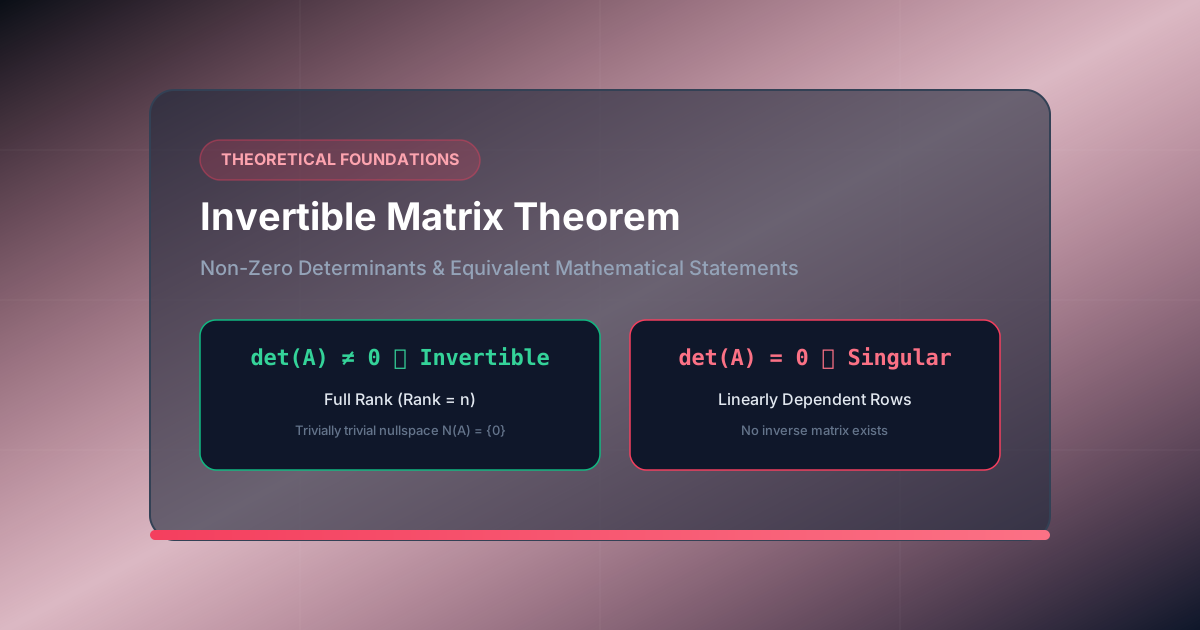
Direct Answer: The Invertible Matrix Theorem proves that for any square $n \times n$ matrix $A$, matrix invertibility ($A^{-1}$ exists) is logically equivalent to $\det(A) \neq 0$, full rank ($\text{Rank}(A) = n$), linear independence of rows/columns, non-zero eigenvalues ($\lambda_i \neq 0$), and unique solvability of $AX = B$.
The Invertible Matrix Theorem is one of the most powerful and unifying concepts in introductory linear algebra. It connects matrix inverse properties, system solvability, linear independence, rank, eigenvalues, and determinants into a single equivalent framework.
At the very heart of this theorem lies a simple condition: the determinant of the matrix must be non-zero ($\det(A) \neq 0$).
What is the Invertible Matrix Theorem?
For an $n \times n$ square matrix $A$, the following statements are logically equivalent. If any single statement is true, all other statements are guaranteed to be true!
- $A$ is an invertible matrix (there exists $A^{-1}$ such that $A A^{-1} = I$, computed via the Matrix Inverse Adjugate Method).
- $\det(A) \neq 0$ (the determinant is non-zero).
- The columns of $A$ form a linearly independent set.
- The rows of $A$ form a linearly independent set.
- $\text{Rank}(A) = n$ (full rank matrix).
- The system $AX = 0$ has only the trivial solution ($X = 0$).
- The system $AX = B$ has a unique solution for every vector $B$, solvable via Cramer’s Rule.
- $\lambda = 0$ is NOT an eigenvalue of $A$ (see our guide on Eigenvalues & Characteristic Polynomials).
- The transformation $T(x) = Ax$ is one-to-one and onto.
Why Is a Non-Zero Determinant Critical?
Geometrically, a matrix transformation maps the unit hypercube to a parallelotope whose volume equals $|\det(A)|$. For more on this, see Calculating Area and Volume Using Determinants.
- If $\det(A) \neq 0$, the spatial volume is preserved (scaled by $|\det(A)|$). The transformation does not collapse space, meaning every point can be uniquely mapped back (inverted).
- If $\det(A) = 0$, the matrix squashes space into a lower dimension (a line or a plane). Information is lost, making it impossible to invert the process.
Practical Applications in Software & Engineering
Testing matrix invertibility is a fundamental prerequisite in computational graphics, finite element analysis, machine learning models, and control systems. Fast numerical algorithms like LU Decomposition verify invertibility in $O(n^3)$ operations.
Engineers use specialized software tools to handle real-world challenges—whether calculating lumber specifications with a construction calculator or analyzing mathematical equations using our advanced online determinant solver.
In digital business environments, structural integrity matters just as much as in mathematics. Digital teams utilize design tools for media processing, streamline healthcare workflows using modern clinic CRM platforms, enforce technical SEO best practices, execute automated campaigns to build backlinks, and connect talented engineers to top career opportunities.
Frequently Asked Questions (PAA)
Can a non-square matrix be invertible?
No. By definition, matrix invertibility requires a square $n \times n$ matrix. Rectangular matrices may possess one-sided pseudo-inverses, but not true two-sided inverses.
What is the relationship between rank and determinant?
If an $n \times n$ matrix has $\det(A) \neq 0$, its rank is exactly $n$. If $\det(A) = 0$, its rank is strictly less than $n$.
How does the determinant indicate unique solutions for linear systems?
If $\det(A) \neq 0$, the linear system $AX = B$ has a single unique solution $X = A^{-1}B$. If $\det(A) = 0$, the system either has no solution (inconsistent) or infinitely many solutions (dependent).
Related Linear Algebra Guides
- Matrix Inverse Adjugate Method
- Cramer’s Rule: Solving Linear Systems
- Eigenvalues & Characteristic Polynomials
Need additional tools?
Explore our complete collection of SEO software, AI tools, business applications, calculators and converters.
Related Resources
Hand-picked web applications and engineering utilities from our network
- • InstantSEOScan – Analyze your website health and uncover ranking bottlenecks with advanced SEO audit tools. AI-powered SEO auditing tools .
- • DentalLeadCRM – Streamline patient scheduling and automate lead management for dental practices. patient management software .
- • JPEGtoSVG – Convert raster PNG and JPEG images into clean, scalable SVG vector graphics. vector converter .
- • Backlink Platform – Publish your site to curated backlink sources and improve organic domain authority. build backlinks .
- • Shahab Dev – Build tailored web applications, enterprise SaaS, CRM solutions, and AI automations. custom software development .