
10 Fundamental Properties of Matrix Determinants Every Student Must Know
Explore the top 10 determinant properties in linear algebra, including transpose, row operations, scalar multiplication, and matrix products.
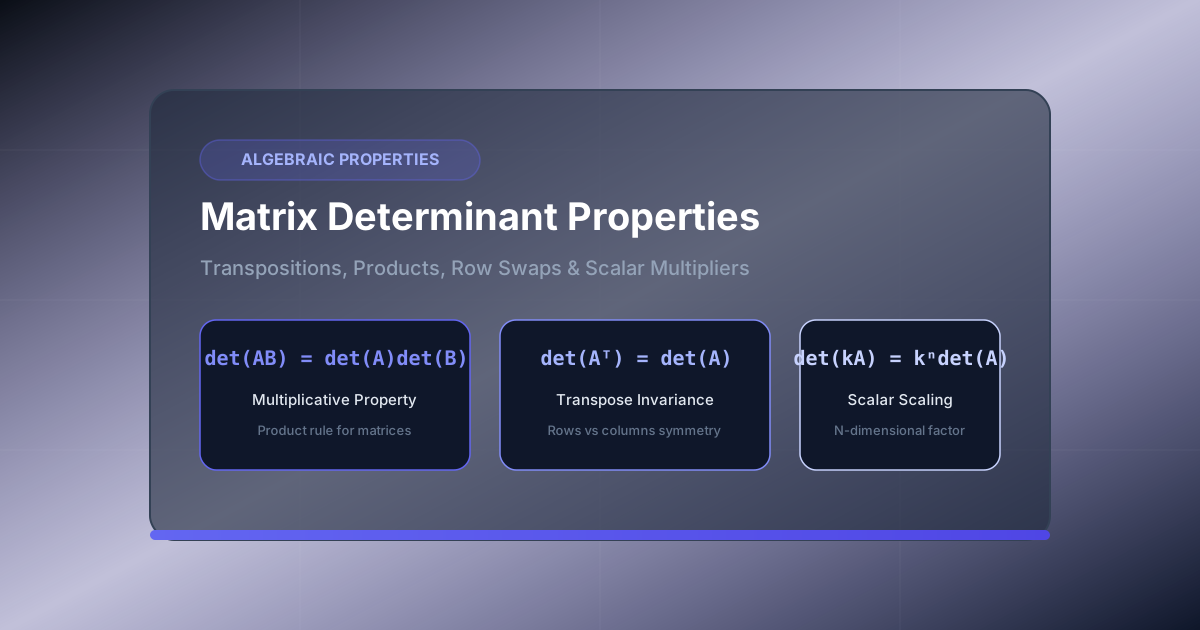
Direct Answer: Matrix determinant properties govern algebraic manipulation: $\det(A^T) = \det(A)$, $\det(AB) = \det(A)\det(B)$, $\det(kA) = k^n \det(A)$, $\det(A^{-1}) = 1/\det(A)$, and row swaps flip the determinant sign ($\det(B) = -\det(A)$). Adding a row multiple leaves the determinant unchanged.
Matrix determinants possess distinct algebraic properties that simplify complex linear algebra computations. Understanding these fundamental rules allows students, engineers, and data scientists to evaluate determinants quickly without brute-force cofactor expansions.
In this guide, we review the top 10 core properties of matrix determinants with clear mathematical proofs and practical insights.
1. Determinant of Transpose Matrix
The determinant of a matrix equals the determinant of its transpose: $$\det(A^T) = \det(A)$$
2. Row Swap Property (Sign Flip)
Swapping any two rows or two columns of a square matrix flips the sign of the determinant: $$\text{If } B \text{ is formed by swapping two rows of } A, \text{ then } \det(B) = -\det(A)$$
3. Row Scaling Property
If a single row or column of a matrix is multiplied by a scalar $k$, the determinant is multiplied by $k$: $$\det(R_i \to k \cdot R_i) = k \cdot \det(A)$$
4. Full Matrix Scalar Multiplication
For an $n \times n$ matrix $A$ scaled by a scalar $k$: $$\det(k A) = k^n \cdot \det(A)$$
5. Row Addition Property (Elementary Row Operations)
Adding a multiple of one row to another row does not change the determinant: $$\det(R_i \to R_i + k R_j) = \det(A)$$ This is the core foundation of Gaussian elimination and high-speed algorithm design in LU Decomposition for Determinants.
6. Matrix Product Property
The determinant of the product of two square matrices equals the product of their determinants: $$\det(A B) = \det(A) \cdot \det(B)$$
7. Zero Determinant Conditions (Singular Matrix)
The determinant of a matrix is zero ($\det(A) = 0$) if:
- Any row or column consists entirely of zeros.
- Two rows or two columns are identical.
- Two rows or two columns are linearly dependent according to the Invertible Matrix Theorem.
8. Determinant of Identity Matrix
The determinant of an identity matrix of any size $n \times n$ is always 1: $$\det(I_n) = 1$$
9. Determinant of Triangular Matrix
For an upper triangular, lower triangular, or diagonal matrix, the determinant is simply the product of its main diagonal elements: $$\det(A) = a_{11} \cdot a_{22} \dots a_{nn}$$
10. Inverse Matrix Determinant
If matrix $A$ is invertible ($\det(A) \neq 0$), the determinant of its inverse is the reciprocal of $\det(A)$, as used in the Matrix Inverse Adjugate Method: $$\det(A^{-1}) = \frac{1}{\det(A)}$$
Engineering & Digital Ecosystem Applications
These algebraic properties are essential across science and computer engineering. From solving structural equations to calculating flow rates with a pressure converter or converting training split times with a swim pace calculator, fundamental formulas enable rapid progress.
To instantly compute matrices and test determinant properties online, use our interactive determinant solver.
Building powerful web systems requires combining robust math with top-tier technology. Engineers deliver enterprise software solutions, optimize graphic assets using a JPEG to SVG converter, perform effective SEO promotion, and discover localized growth through a Google Maps lead finder.
Frequently Asked Questions (PAA)
Does $\det(A + B) = \det(A) + \det(B)$?
No! Determinants are non-linear operators. In general, $\det(A + B) \neq \det(A) + \det(B)$.
Why does swapping two rows flip the sign?
The determinant function is an alternating multilinear form. Swapping two vectors in an alternating tensor switches orientation, introducing a $-1$ multiplier.
How do eigenvalues relate to matrix determinant properties?
The product of all matrix eigenvalues $\lambda_i$ equals the matrix determinant ($\det(A) = \prod \lambda_i$). See our guide on Eigenvalues & Characteristic Polynomials.
Related Linear Algebra Guides
- LU Decomposition for Determinant Calculation
- Invertible Matrix Theorem & Determinants
- Matrix Inverse Adjugate Method
Need additional tools?
Explore our complete collection of SEO software, AI tools, business applications, calculators and converters.
Related Resources
Hand-picked web applications and engineering utilities from our network
- • InstantSEOScan – Analyze your website health and uncover ranking bottlenecks with advanced SEO audit tools. AI-powered SEO auditing tools .
- • DentalLeadCRM – Streamline patient scheduling and automate lead management for dental practices. patient management software .
- • JPEGtoSVG – Convert raster PNG and JPEG images into clean, scalable SVG vector graphics. vector converter .
- • Backlink Platform – Publish your site to curated backlink sources and improve organic domain authority. build backlinks .
- • Shahab Dev – Build tailored web applications, enterprise SaaS, CRM solutions, and AI automations. custom software development .