
Connecting Determinants to Eigenvalues: Calculating Characteristic Polynomials
Learn how determinants define the characteristic equation det(A - lambda*I) = 0 to calculate matrix eigenvalues and eigenvectors.
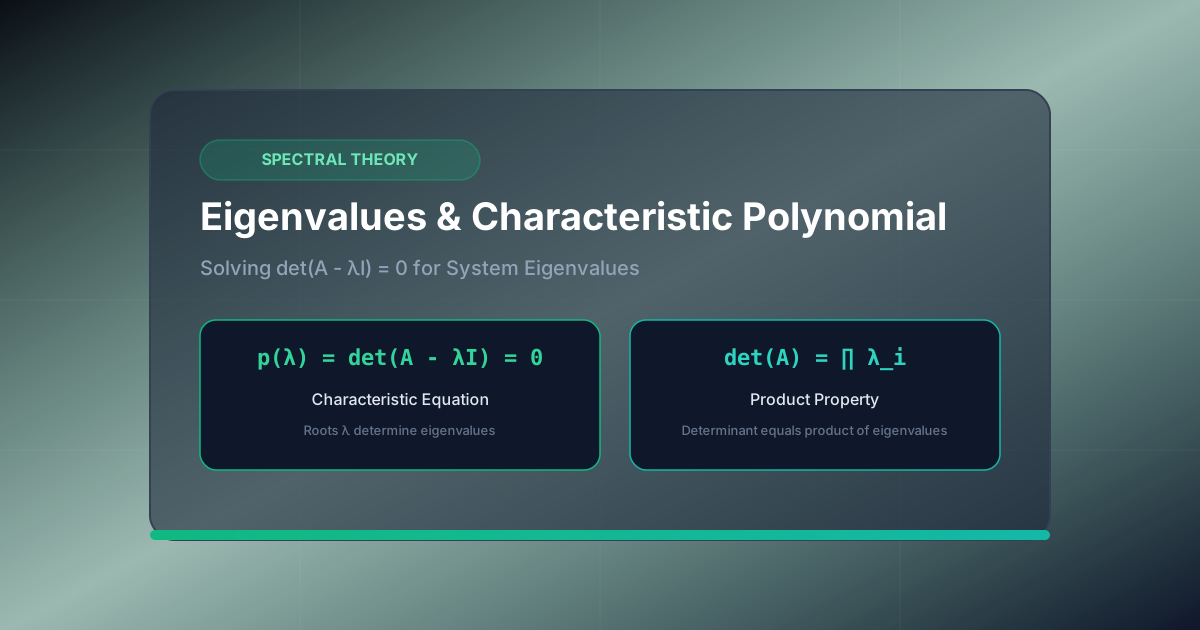
Direct Answer: Eigenvalues are scalar values $\lambda$ that satisfy the characteristic equation $\det(A - \lambda I) = 0$. Setting the matrix determinant of $(A - \lambda I)$ to zero guarantees that the matrix is singular according to the Invertible Matrix Theorem, allowing non-zero eigenvector solutions $v$ such that $Av = \lambda v$.
Eigenvalues and eigenvectors are fundamental pillars of linear algebra, quantum mechanics, principal component analysis (PCA), structural vibration analysis, and machine learning models.
At the center of eigenvalue calculation lies a crucial matrix expression: the characteristic polynomial, defined directly by a determinant:
$$\det(A - \lambda I) = 0$$
In this guide, we explore how matrix determinants are used to derive characteristic polynomials and solve for matrix eigenvalues.
What is an Eigenvalue?
For a square matrix $A$, a non-zero vector $v$ is called an eigenvector if multiplying $A$ by $v$ yields a scaled version of $v$:
$$A v = \lambda v$$
Where $\lambda$ is a scalar known as the eigenvalue.
Rearranging the equation:
$$(A - \lambda I) v = 0$$
For a non-zero eigenvector $v$ to exist, the matrix $(A - \lambda I)$ must be singular (non-invertible). According to the Invertible Matrix Theorem, a matrix is singular if and only if its determinant equals zero:
$$\det(A - \lambda I) = 0$$
This is known as the characteristic equation of matrix $A$.
Step-by-Step Example: Finding Eigenvalues of a 2x2 Matrix
Let’s calculate the eigenvalues for matrix $A$:
$$A = \begin{bmatrix} 4 & 2 \ 1 & 3 \end{bmatrix}$$
Step 1: Form $(A - \lambda I)$
$$A - \lambda I = \begin{bmatrix} 4 - \lambda & 2 \ 1 & 3 - \lambda \end{bmatrix}$$
Step 2: Compute $\det(A - \lambda I)$
$$\det(A - \lambda I) = (4 - \lambda)(3 - \lambda) - (2)(1)$$ $$= (12 - 7\lambda + \lambda^2) - 2$$ $$= \lambda^2 - 7\lambda + 10$$
Step 3: Solve the Characteristic Equation $\lambda^2 - 7\lambda + 10 = 0$
Factoring the quadratic equation: $$(\lambda - 5)(\lambda - 2) = 0$$
The eigenvalues of $A$ are: $$\lambda_1 = 5, \quad \lambda_2 = 2$$
Key Eigenvalue Properties Involving Determinants
- Product of Eigenvalues: The product of all eigenvalues of matrix $A$ equals the determinant of $A$, reflecting fundamental Matrix Determinant Properties: $$\det(A) = \prod_{i=1}^n \lambda_i$$
- Sum of Eigenvalues (Trace): The sum of all eigenvalues equals the trace of $A$ (sum of diagonal entries): $$\text{Tr}(A) = \sum_{i=1}^n \lambda_i$$
- Invertibility Check: If any eigenvalue $\lambda_i = 0$, then $\det(A) = 0$, proving $A$ is non-invertible.
- Spectral Applications: In physics, eigenvalues determine principal stresses and normal modes. Learn more in Applications of Determinants in Physics and Engineering.
Interconnected Tools & Modern Technology
Computing eigenvalues and characteristic polynomials underpins modern engineering algorithms. Civil engineers calculate natural frequencies of structures alongside lumber metrics using a wood calculator.
To experiment with matrix equations, test inputs on our online determinant solver.
In modern software ecosystems, technical rigor powers digital growth. Companies improve platform visibility through an SEO audit, boost domain trust with website authority tools, convert visual media using an image converter, automate sales pipelines using lead management software, and hire top talent in tech careers.
Frequently Asked Questions (PAA)
Can a matrix have complex eigenvalues?
Yes! If a real matrix has a characteristic polynomial with complex roots, its eigenvalues occur in complex conjugate pairs.
What is the relationship between $\det(A)$ and eigenvalues?
The determinant of matrix $A$ equals the product of all its eigenvalues ($\det(A) = \lambda_1 \cdot \lambda_2 \cdots \lambda_n$). If $\det(A) = 0$, at least one eigenvalue must be zero.
What is the degree of the characteristic polynomial for an $n \times n$ matrix?
The characteristic polynomial of an $n \times n$ matrix is always an $n$-th degree polynomial in $\lambda$.
Related Linear Algebra Guides
- Invertible Matrix Theorem & Determinants
- Matrix Determinant Properties Explained
- Real-World Applications in Physics & Engineering
Need additional tools?
Explore our complete collection of SEO software, AI tools, business applications, calculators and converters.
Related Resources
Hand-picked web applications and engineering utilities from our network
- • InstantSEOScan – Analyze your website health and uncover ranking bottlenecks with advanced SEO audit tools. AI-powered SEO auditing tools .
- • DentalLeadCRM – Streamline patient scheduling and automate lead management for dental practices. patient management software .
- • JPEGtoSVG – Convert raster PNG and JPEG images into clean, scalable SVG vector graphics. vector converter .
- • Backlink Platform – Publish your site to curated backlink sources and improve organic domain authority. build backlinks .
- • Shahab Dev – Build tailored web applications, enterprise SaaS, CRM solutions, and AI automations. custom software development .